Sharing a Respiratory Life
In August 2022, I left CourCommune, the arts residency in Voulx, France, where I had spent over a month writing. While my book was completed during that month, my conversations with the artist Anne Brochot, director of the residency, had just started. Gardeners and art—in some of our last in-person conversations, Anne explained how she had discovered in her residency the intimate relationship between her body and greenery, what it means to breathe in the same space as plants. In French, expirer, or “exhale,” is a synonym of “to die.” The exchange of life and breath is the essence or our relationship to what is green.
Through the residency and her own garden, Anne recognizes the breath and breadth of greenery. Greenery exists not only in those spaces that produce crops, but also in landscaping and other green spaces. This inclusionary vision of greenery guided Anne to learn more about the history of plants. The next phase of her project Nous, la verdure (Us, the Greenery), explored how to add more dimension to our relationships to nature. Anne created a leaf printing workshop to provide a more sensual understanding of humans’ relationship with greenery. In Thiérache, she gave a talk on the history of the vegetation that provides the ultra-thin layer of atmosphere in which we breathe. We breathe before we walk, without any effort, without thinking about it, without having to learn it. Breathing is our way of being in the world, of blending into the world. As the philosopher Emanuele Coccia said: “We are more atmospheric creatures than terrestrial ones. The life cycle of the plant creates the layer of earth from which man can feed and create a whole host of objects.” Plants are everywhere. And for Anne, allowing workshop participants to understand, to enter, and be part of that legacy is an important outcome of her art.
An Imprint
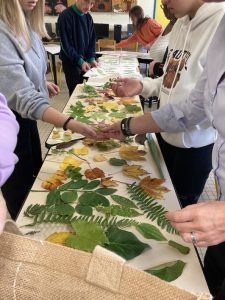
In her workshops, Anne asks each participant to choose a particular piece of vegetation. Then they connect with plants in a tactile and intimate way—by creating prints. For Anne, prints are much more than an image; they are traces of history.
In workshop with Anne, participants feel, hold, and work with specific leaves to recognize the complexity, structure, and life-giving forces of the leaves. Nous, la verdure guides attendees practically and spiritually through the day’s activities, directing sensory experiences and providing printing instructions.
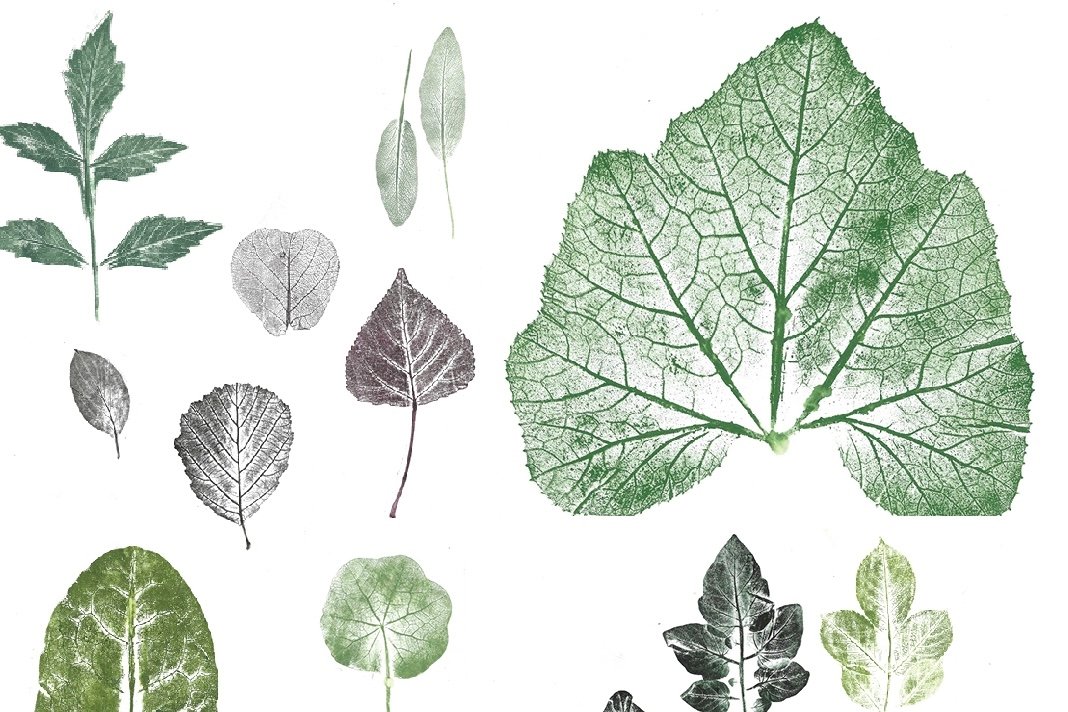
Everyone chooses a “vegetable alter ego”—grass, hogweed leaf, the leek, or willow leaf—depending on where they are. A plant with which it is possible to imagine a continuity of breathing, vital intimacy. The print they make will reveal a familiar but overlooked plant, allowing all to notice the delicacy and beauty of ordinary greenery. One impression is made for the participant, another as a work test, and one for Anne’s huge and impossible collection of prints. This library is now called Le Fol Inventaire—the Crazy Inventory.
Images of prints and linocut made in Anne Brochot’s workshops.
A Garden Portrait
In guiding a group of workshop participants, Anne tells them: “With several hands, we will make the portrait of the garden we visited and the leaves we chose. Without bothering to know how to or how not to draw, let’s create the portrait of our intertwined lives, like so many entangled territories. Our breaths mingle like this; our aspirations to ‘be human on Earth.’ The portraits will be drawn in connection with the prints made in the garden.”
Anne’s belief that we share a respiratory life with greenery is the driving force behind her artistic engagement with residents and students. It’s not only a matter of printing a leaf. It is also about creating an intimacy with the leaf that one has chosen, recognizing a consciousness that plants provide us with—the essence of our existence. “When we exchange breath with the leaf, we are sharing a respiratory life, une amitié pulmonaire, a lung friendship—one which has existed for millions of years,” she says. For Anne, allowing the participants to understand, to enter and be part of this legacy is an important outcome of this work.
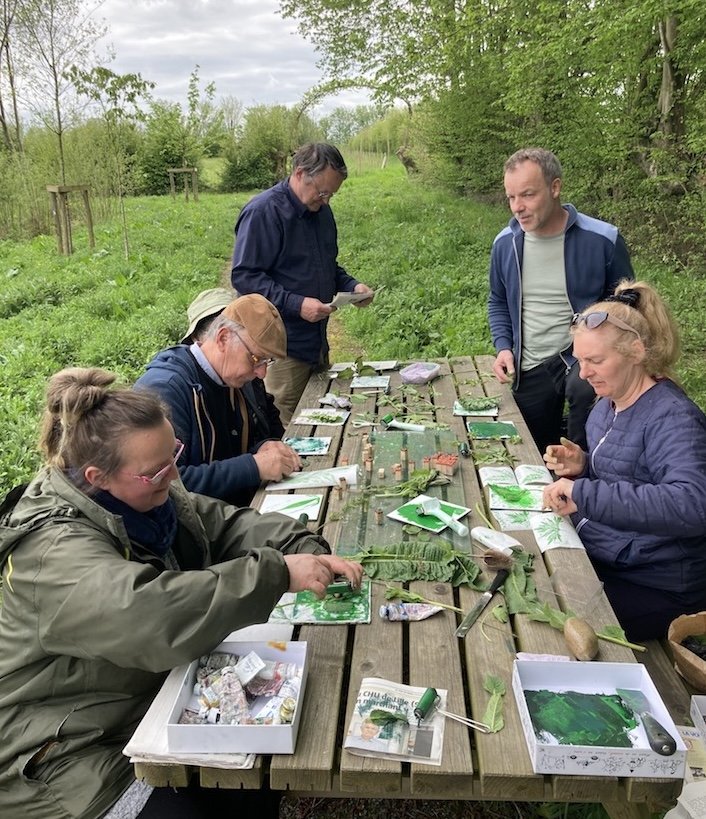
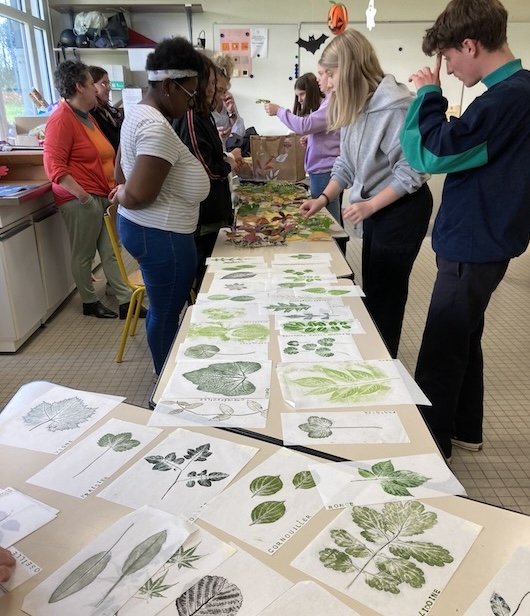
Printmaking workshops with greenery.
I don’t speak French. Anne is fluent in English, but it is sometimes difficult communicating about her influences, techniques, and inspirations. To help me, she wrote out and translated her philosophies, sent me her brochures and books, and included very specific and clarifying photographs. I regretted not attending her printing workshop when she invited me. Because I never had that hands-on experience, like one of the gardeners, my sensibility was limited. I didn’t feel prepared to deliver something that reflected even a percentage of this project.
In early 2023, Anne mentioned that she was preparing to present Nous, la verdure at a festival in May. All the artists working in Thiérache would be there, performing traditional songs, staging historical productions, telling stories. The festival would take place at La chambre d’eau as part of their biennial festival, Eclectic Campagne(s). The three-day event, according to the organizers, goes to “the heart of the challenges of the contemporary world born from the invitation made to artists to offer the experience of a second wind. The one that brings new energy when we seem to lose all strength and that allows us to dream again!”[1]
Building Greenhouses
In the last week of May, I met Anne at the train station in Aulnoye-Aymeries, near the Belgian border, to attend the festival. This part of France has deep hues, brick houses, dense greenery. Large animals grazed in less-groomed and contained fields than in at CourCommune in Île-de-France. The village streets reminded me of the mews in London, with shops close to the road and lines that lifted and swerved with the landscape.
After we dropped our bags, we headed to where the festival was being held. The terrain was reminiscent of rural Pennsylvania, where I grew up. Creeks ran along the road, small stone bridges covered the passages, tree limbs hung across the road, creating a canopy. All along the way, through the town and to the festival, Anne described the schedule and what I should expect. Her back seat was packed with supplies in crates. Tomorrow the public would arrive, and she had to get the greenhouse ready today.
La chambre d’eau resides on the grounds of an old water mill and has kept much of area wild and natural. We pulled a loaded trolley and carried tools and paper through the entrance. My first glimpse of the festival was of a grown-over fairgrounds with a big top. Later, I learned that La chambre d’eau’s principles of land use included not interfering with the terrain. Where Americans might have cut lawns, put up fences, and created signage, they sliced paths through the tall grass, used string to mark barriers, and posted handmade signs, sometimes using a pun or joke in the message.
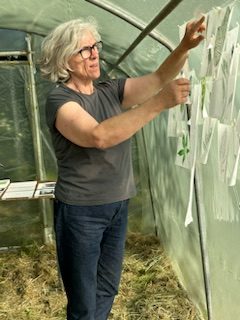
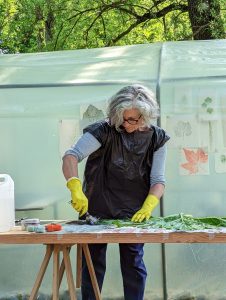
Anne Brochot arranging prints in the greenhouse.
When we reached Anne’s spot, the frame of the greenhouse was already standing. She had used PVC pipes and plastic sheets to erect a hut that had room for two worktables and several visitors. Around the outside sat chairs, large logs, and another table made from plywood. Inside she had arranged prints from workshops along the walls. The tools for printing were organized and the tables pushed together.
I looked around at the other exhibits and services being set up. Next to us, an outdoor storytelling circle was arranged near mules tied to a tree. I later learned that some artists and participants traveled by mule and bicycle to avoid using fossil fuels. Beyond our site, I could see art installations, large sculptures, stages, trapeze lines, and small film-screening structures.
The festival had sprung from the ground like the wide, shady trees around it. A sense of reverence permeated the atmosphere. It was the tone set by La chambre d’eau: rather than inviting artists to hide in nature, they welcomed artists (and the guests) to join nature, to engage with the region, and to find inspiration. The longtime supporter Réjane Sourisseau told me that La chambre d’eau “…focuses on those who see these territories not simply as a setting or a source of inspiration, but as [living] environments, opening up spaces of resistance to dominant discourse and models through collective initiatives combining artistic imagination, ecological, and agricultural transition.” Sourisseau continued, “Far from being limited to a spatial status, the rural is not the opposite of the urban. It exists in its own right, rich in singularities, linked by multiple dynamics and interdependent relationships on scales far beyond the local.”
La chambre d’eau’s mission permeates its structure. The organization and administration mirror the mandate not to colonize or impose on the territory, but to join it and bring entities in it together. Vincent Dumesnil, codirector of La chambre d’eau, pointed out that the board comprises local farmers, a factory secretary, artists, educators, and others. Moreover, the interaction between La chambre d’eau and the community not only built good relations, but also to provided resources for the artists and opportunities for local inhabitants.
The festival theme in 2023, Utopia/Dystopia, produced not only a range of art, spectacles, and events, it was also demonstrated in the functions of the festival from the use of terrain to food sourcing and quality, program accessibility, and the sense of freedom that permeated the weekend. Local organizations fed hundreds of people. Paper plates and plastic cups were nowhere to be found. Instead, everyone was handed a plate that they cleaned in the dish bin after they ate. The toilets used saw dust, everything was recycled, and tokens served as drink tickets.
Sixty volunteers of all ages and occupations joined in to create a successful festival. The community provided support, too. For instance, a stage needed to be moved for a play that would be performed later in the day on Saturday. A local farmer came with his tractor to haul the stage to the spot. Vincent told this story with gratitude. “I love thinking about him one moment with his cows and then, the next, moving a stage for a play.” The farmer became a participant of the festival as well.
This confirmed Dumesnil’s idea of exchange: “This idea is really specific because it’s private, but it’s open to public, so things are really permeable. Porous—it’s a word I like. Porous means there is an interaction . . . and this interaction builds something.”
Anne’s project also embodied the freedom of these interactions. Her greenhouse buzzed with participants long after the festival had officially ended. Anne gave a talk on the history of the greenery, demonstrating how to flatten a leaf on the table, place the paper right on top of it, and press on the ink with a roller. As the images appeared, in their finest detail, each participant seemed to inhale the breath of it, to feel joy. Children and adults stamped plants names in little stamp letters and posted their productions until the walls of the greenhouse were covered.
I witnessed the care with which each participant selected their leaf. How they held it against their hand, placed in on the table, watched the transformation as the ink raised the images. The beauty was in the simplicity of the act. Engaging the senses, using muscles, and creating a beautiful final product all verified the objective—everyone celebrated their piece of art and their connection with nature.
On our drive back to Voulx on Sunday night, Anne acknowledged: “I would not have developed this project without La chambre d’eau. The extensive amount of time gave me opportunity to be thoughtful, be organic and go deep.” She described the last step of the project in La chambre d’eau before it will shift to CourCommune for another three years: Le Fol Inventaire, or the Crazy Inventory, an attempt to catalog all the plants in the world. Impossible, she confirmed, even before I asked the question. But we are many, everywhere over the world.
In her next workshop, Anne will share the text and methodology of Le Fol Inventaire with a group of printers. They will learn how to work with groups to make prints and keep Le Fol Inventaire growing. A website for Le Fol Inventaire launched in spring 2024 and a book is being assembled to chronicle the trajectory of the workshops and the community involvement.
“This process has no ending,” says Anne. Much like her relationship to the garden, the project’s renewal is ongoing.
Notes
[1] La chambre d’eau, “Festival Eclectic Campagne(s) 2023,” https://www.lachambredeau.fr/eclectic-campagnes-2023.
Image Credits: Images courtesy of Anne Brochot.
Quotes are taken from personal communication with the author.