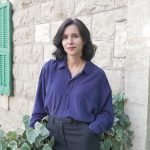
Valerie and Louisa are experience designers, community practitioners, and close friends who live in Berlin and Bangkok, respectively. As Germans with roots in Arab countries, they engage here in a conversation about food and the natural world as a means to come home to their bodies and the land, even as they live far from the ones they are seeking to connect with.
Their letters, written in June and July 2024, touch on several creative collaborations: a documentary film about Valerie’s paternal family in Lebanon; a multi-local dinner experience they codesigned with the Palestinian artist Mirna Bamieh[1]; and an artistic installation for a large street festival in Berlin, involving an olive tree as a host for public grief and dreams of liberated futures.
*********
Dear Louisa,
Home, sometimes, is a very simple thing, don’t you think? The place we find food. The place where we’re offered food. Or the place we’re offering: to friends, to family, to strangers.
Do you remember the late, hot, Lebanese afternoon lunch we had in Ehden after we met my family in Tripoli for the first time? It feels far away now, but I vividly recall how we analyzed the dynamics of estranged family relationships over the most generous assortment of melons, pineapple, grapes, apples, baklava, and cactus pears. And how we found that, even if we are strangers, we still offer. We still accept. In generosity or in humility, either way, in togetherness, we sat, ate, laughed, and conspired.
Day after day, we returned and were offered more food. Coffee first, then knafeh, a city lunch. We spent our last day all together by the beach, sharing grilled fish, salad, and fries, until we were sent home with a brown paper bag, filled with groceries, in a country in crisis, where access to food depends on its affordability. I remember feeling at home that day, and how you taught me to say “tomato” in Arabic as the sun set over the Mediterranean Sea.
It was a simple, transient home, beginning and ending with seats taken at the table and colored by the open secrets of my family, consciously left untouched.
Dear Valerie,
I clearly remember that afternoon in Ehden, whose origins your imagination traced to a place that must have witnessed paradise at some point. Our endorphin levels rose with each honeyed piece of fruit we ate, and then we clinked glasses “to our secrets,” adopting the phrase we’d learned the night before.
A year before our trip to Lebanon, I investigated my paternal family’s saga in Algeria. It helped me understand my brother’s, father’s, and my own love for olive trees, and how that love must stem from a lineage of growing food. I learned that, in a twist of fate, my great-grandfather had lost his land, and with that loss, the land somewhat disappeared from our memory. My father’s departure to Europe sealed the end of our agricultural land ownership. We made it our vow to at least migrate one younger olive tree from Algeria to my Berlin apartment.
At the nursery in Algiers, I immediately connected with a crooked specimen, sensing that we could see into each other’s souls. At the airport a few days later, a customs officer asked my father what he carried in his hand luggage. “Is that a tree?” Shrugging, my father responded, “Yes, my daughter wants to bring an Algerian olive tree to her home in Berlin.” The officer, agitated, gestured: “No, you cannot do that. There is sacred soil on the tree’s roots; it carries the blood of those who liberated this country. It is prohibited to take soil from this land out of Algeria. Do you understand?” Not much would add to his knockout argument, and certainly it wasn’t the setting for disputes.
Disheartened, my father left the tree with his cousin who was working at the airport and then boarded his flight. The next time he visited, he picked up the tree and wrapped it diligently, not to be spotted in his checked luggage. The tree and some of its sacred soil migrated north during another season.[2]
Yes, I do think that home, sometimes, is a seemingly simple thing.
Dear Louisa,
I am swooning over your father’s mischievous dedication to carrying your soulmate olive tree all the way from Algeria into your waiting arms. What magnificent demonstration of his love for you. I think you may have inherited it, though in different ways.
“One loves with the belly,” we say in German, and as your best friend, I know this to be true. Rarely do I feel as loved as when you invest hours in researching vegan recipes and restaurants, or shop for allergy-friendly ingredients when I visit you every year for my birthday. Or when you asked me to travel halfway through Berlin to get that special saj bread, without which the musakhan we had envisioned for our dinner series simply couldn’t be enjoyed to its complete flavor, all for us to share a fullness that feels like dedication, love, and home.
It is those details that make all the difference. Food is a love language of sometimes obsessive devotion. Certainly, it is yours.
Dear Valerie,
Admittedly, I had to smirk at your last letter. Of course, I’d travel across the city to get that one kind of bread to be able to serve an honest, dignifying meal.
When you visited last time, I was reading Rebecca Johnson’s Small Fires: An Epic in the Kitchen, in which she describes how Audre Lorde’s mother, Linda, developed an “expert geography of buying butter in New York.”[3] Linda refused racist segregation and the logistic obstacles it would force on her access to food items, so she would go to great lengths to be able to cook exquisite meals and lend dreams of liberation an earthly form. Linda’s context is, of course, a very different one, and my drive to organize a day around the acquisition of food is not a political necessity, thankfully.
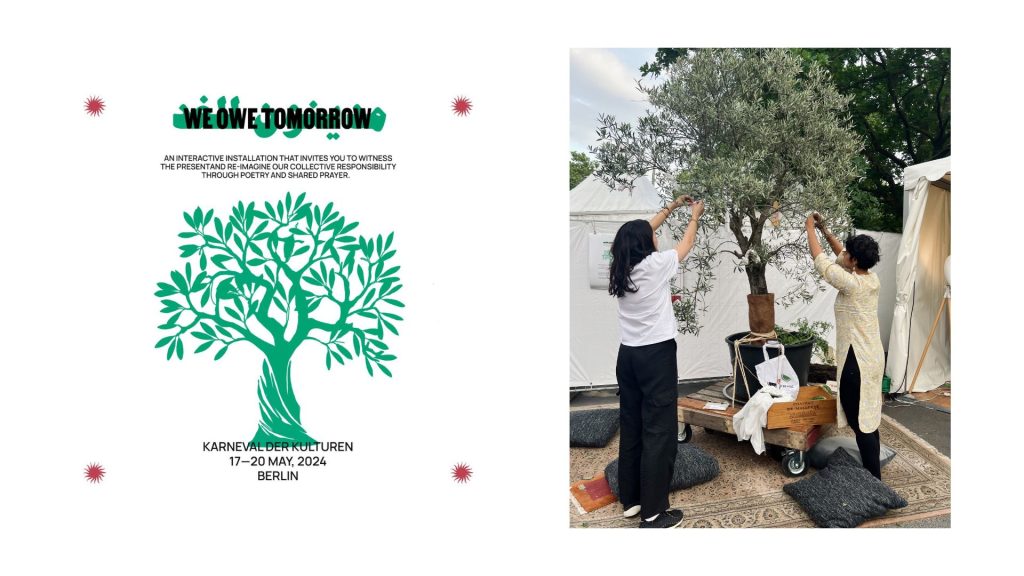
I feel this is connected to our olive tree installation for the Karneval der Kulturen in Berlin this spring.[4] The tree became a host for mourning prayers and hopeful wishes of liberated lands and peoples. We initially feared attacks, but somehow, moving an uprooted olive tree through public space, while people hummed to the rhythms of their city’s cultural multitudes, was strangely transformative. Even fruit sellers chimed in and distributed slices of watermelon.
Others simply sought refuge in the shade and calm the tree provided, oblivious to its meaning or significance. Perhaps a tree that nurtures us, that offers rest, invites more caring forms of protest?
Dear Louisa,
You’re so far away. I miss you as we are writing these letters from Bangkok and Berlin. I wished we could have had the sweet watermelon juice drop down our jaws together as I was pulling the olive tree through a springing Berlin.
But even across all this distance, I feel you are here with me. Last week, I invited a man into my kitchen; he’s from Lebanon. As he was looking around, he picked up Sami Tamimiand Tara Wigley’s cookbook Falastin—the one we once had to exchange because I gave you a gift for your birthday that you already had. “Do you have za’atar?” he asked, without any imminent necessity or consequence.[5] I smiled with silent pride, showed him the za’atar you had brought me back from Lebanon, and felt more Lebanese than before.
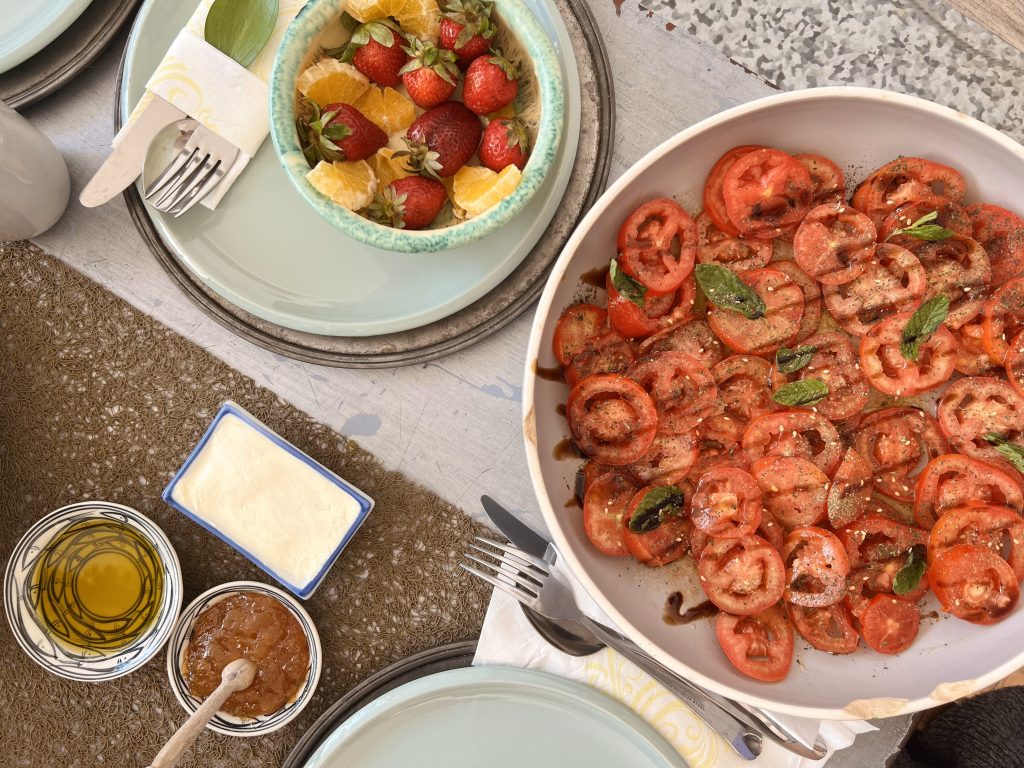
His inquiry reminded me of a few months ago, when I was hosting a creative retreat in Tunisia. It’s still funny to me that Jamila, the owner and chef at Villa Ma-Amoura, knew our common friend Gab, although neither you nor I had seen him in years. He must be in Beirut now, although he travels to Tunis often. Jamila delighted everyone with the delicious detail and surprising flavor she infused into every meal, and on Sunday, she brought us freshly sliced tomatoes for breakfast, graced with her homemade olive oil and seasoned with za’atar, of course. Smirking, she turned to me and pointed at the plate that had already brought pure excitement to my face as it was. “This za’atar is from Gab’s grandmother in Lebanon,” she said. “He brought it with him the last time he came.” I paused in disbelief and wondered, then, if she had a sense of your adventures many moons ago, on a Vespa in Beirut’s summer.
For a moment, we were there all together, with Gab’s teta, his grandmother, and the photo that reached you just a few minutes later, thousands of kilometers away in what I imagined to be a heated, stuffy Bangkok afternoon, brought us home to each other and the land. Za’atar bridges many distances in this world.
Dear Valerie,
I miss my coconspirator in troublesome and liberatory affairs, too. It was hard not to be in Berlin when our installation took shape. All I could do was morally support you from afar and send my brother and father to accompany the tree.
Totally agree with you on za’atar’s distance-defying capabilities. I have just given my remaining stock to an Indonesian friend, who will organize the Jakarta edition of our dinner experience in solidarity with Palestinian people. I’ll never forget the moment Mirna [Bamieh], during preparations, shared that she never travels without za’atar, or else an important piece of home would be missing.
Bringing this dinner to Bangkok, where I am a guest, and making space for others and frankly also myself, to witness this genocide, and where the scarcity of food has become a weapon, yes, being able to grieve in community has made this city a home to me, eventually. I felt even more connected, knowing that you were hosting the dinner in Tunis the same day, along with other people in other places.
Alongside Mirna, we wondered how we could possibly witness and share the grief of famine over food. “People will leave the dinner hungry, and they will have to work for it,” she said. We needed this clarity to overcome our hesitations, yet we filled the space with dignity, poetry, and silence around delicious, albeit scarce, food offerings.
Dear Louisa,
I have long wondered, what is home? That “amorphous and mystically perfect place,” which too often is real only in my mind’s eye?[6] I’m yet to find an answer, but somehow it becomes tangible the very second I open a door, and the scent of onions, spice blends, and olive oil heating in the pan floods my nostrils with a single inhale, taking me back into the present, back to a momentary place of safety around the dinner table, where I can see how we are all moving in relation to one another.
I see how I am, like each seed, a beginning, continuation, and ending to something—to what came before, is now, or will come after me. With this sense of belonging to something beyond my own life cycle, home becomes a part of me, and me a part of home. A home for which we all carry the shared responsibility of protection.
Maybe this is what finally gave you that feeling of arriving in Bangkok. When we share food in its most authentic form, we can be present in our bodies and in the world together. To me, being present is another way of feeling at home, rendering it almost impossible to disconnect from what is happening around us.
When creating experiences for friends, family, or strangers, we often discuss how the magic of community tends to happen in the moments in between, the liminal, finite space of togetherness. Programming, if it exists, becomes an excuse to gather, an excuse to open up, for a prolonged period, to simultaneously share and create life, stories, and memories over breakfast, lunch, and dinner.
Which, maybe, is what food is all about. Coming home together, to ourselves and the world, wherever we are.
Image credits
Featured image: “Paradise”, by Valerie Marouche, all rights reserved.
Second Image: “We Owe Tomorrow, Olive Tree Installation”, poster by Yusuf Akın Gülsayın, hi.studio; image by Valerie Marouche, all rights reserved.
Third Image: “Zaatar”, by Valerie Marouche, all rights reserved.
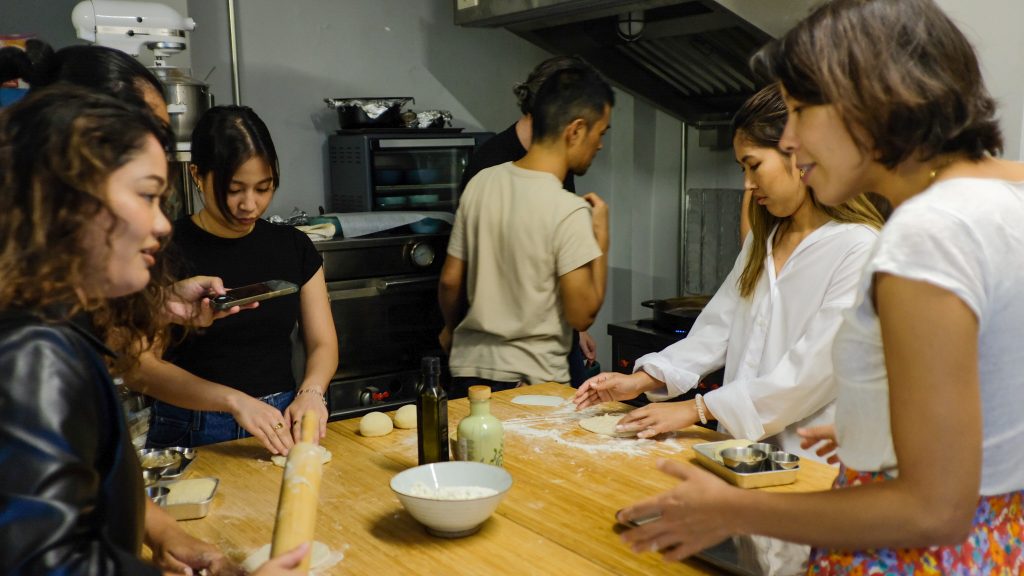
Fourth Image: “Opening Space for Jasmine, a multi-local dinner experience”, by Louisa Mammeri, all rights reserved.
Notes
[1] The dinner experience can be organized by interested hosts, following a set of guidelines that can be shared upon request. These include a set menu, agenda, recommendations on guest invitations and setting, as well as access to visual and sound elements designed and recorded for the experience.
[2] A loving ode to Tayeb Salih’s 1966 novel Season of Migration to the North,trans. Denys Johnson-Davies (Penguin Classics, 2003).
[3] Rebecca Johnson, Small Fires: An Epic in the Kitchen (Pushkin Press, 2023), chap. 4, Kindle.
[4] The Carnival of Cultures is Berlin’s biggest street festival celebrating postmigration identity and diversity.
[5] Za’atar (“thyme”; Arabic) is a multifaceted spice blend of different flavors, textures, and fragrances. It varies but is generally a combination of dried oregano, thyme, marjoram, sumac, and toasted sesame seeds.
[6] Audre Lorde, Zami: Another Spelling of My Name Crossing Press, 1982), 71.